Wednesday, March 9, 2022

Is Giant DNA Still With Us Today?

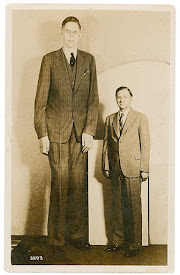
Robert Wadlow and His Father, before 1937

As far back as ancient Greece herself, there have been stories of giants who walked the Earth, made trouble for smaller people, and even unsuccessfully warred against the Gods. While people today scoff at the idea as a mere fairytale or a story invented to make kids go to bed, I've taken time to do my own brainstorming as a mythologist on the topic, and I have developed a theory to present. Generally put, the stories of giants are not false, incorrect or misinterpreted.

Let's begin by examining the average height of an ancient Greek male, which was 5'7". Even today in America, that has only increased by 2 inches. Six footers and above like myself, are not the norm. However, we also know that there have been extremely rare cases of people who have grown to extraordinary size and height, such as Andre the Giant and Robert Wadlow, Andre being 7'4" and Wadlow 8'11", and from my own state of Illinois. 

These incredibly large people achieve their status not through a fairytale, but hard genetics. Both men had what is called gigantism, which is the result of abnormal or very overactive hormones and glands. And here's the kicker about Wadlow; at the time of his death, they could not conclude that he had reached his maximum growth. That's right, it is possible that he could have gotten even bigger. He also possessed amazing strength, perhaps the kind that would have been used to help build what we know as the Cyclopean Walls.

An average person looking up at these colossal people would certainly think of them as what they literally are, giants. Because these conditions of great size are science, what if it is, in fact, the rare DNA of ancient giants, that continues to sometimes be handed down through the human line? People today think of giants as those who reach to the clouds, and are even monsters, but that doesn't have to be the case. To me, there is no question as to whether giants existed. We have seen them with our very eyes.

Our ancient past isn't as distant as we have been led to believe, nor are the old stores as far fetched as we have been taught by the modern education system.

In the Goodness of the Gods,

Chris Aldridge.

Sources: 

https://en.wikipedia.org/wiki/Robert_Wadlow

Monday, March 7, 2022

The Shotgun Wedding That Started A Holy War

In the name of liberty, to Apollon's temple once again! 

The bones of the first two sacred wars were now lying still in the soil, but as has been said, only the dead have seen the end of war. 

Historians would more than likely conclude that the conflict had been brewing for a while, but this part of the story starts on the day of a wedding at the sanctuary. A father by the name of Crates became outraged, to say the least, perhaps even insane when his soon-to-be son in law Orsilaus got cold feet and cancelled the marriage. Not only did the father have the groom executed, he also murdered the groom's family members right in the sacred areas of Delphi itself, which was the worst religious offense. The fact that the father supported Theban domination at Delphi and Orsilaus supported Phocis, probably did not aid in resolving tension between the families either. Some say the execution and murders likely had political ends as well as revenge. We will remember that in the last Sacred War, Phocis remained in control of Delphi, and the power struggles between the Cities were far from over.

As punishment for the pollution of murder in a sacred area, Crates and his family were faced with heavy fines, and the feud between Thebes and Phocis over Delphi would only intensify from this point. It all came to a head when the League of Delphi, who has been victorious in the past wars, came to support Theban power, and Phocis, unlike in the last Sacred War, was losing strength and support fast. 

At a meeting between the League and Phocis, which no doubt included talks about the actions of Crates against Osrilaus, the Phocians found themselves to be charged with basically the same thing Crates had been convicted of, impiety, blasphemy, sacrilege, etc. Phocis faced heavy fines as a result. Phocis, however, refused to bow to the League or the emerging Theban power, but at the same time, knew that defiance would inevitably lead to physical confrontation. Therefore, they attempted to end another war before it began. In 356 BCE they conquered Delphi. However, they surely knew that this was not the beginning of the end, but merely the end of the beginning. If they had expected Greece to remain passive, they were wishful thinkers.

That summer, the League forces reunified, retook Delphi, and dethroned Phocis from its position of supremacy. Because of their eventual defeat, and probably their desire to remain important at Delphi, they began to comply with the original demands of the League. But the Third Sacred War was far from even a remote close.

In 355 BCE, the League decided to punish Phocis even more for their actions one year prior and attacked them with military force. The conflict was apparently too much for some of the Phocian leaders to handle, as their General committed suicide and even his replacement was killed in action. Nevertheless, Phocis was determined to take the war to whatever ends necessary to win. They robbed the temple's treasury and broke down valuable metal objects they could find in the sanctuary. This resulted in the immense loss of much of Delphi's history, story and economic stability. The theft was, in large part, to fund their army, but it probably also struck a blow to the spirit of the City, or so they might have thought. Religious work and consultations of the Oracle went on uninhibited.

As the fourth year of the war came in, it was clear that it was only a matter of time before Phocis collapsed, both from bankruptcy and military setbacks. However, a friend of Delphi to the far north would be the one to put the final nail in the coffin: Philip of Macedon, father of Alexander the Great. He had received word from the League and was asked to intervene on their behalf, which he did because of his dealings with and great respect for Delphi. By 346, Phocis was not only thrown completely out of the temple and sanctuary, but banned from having anymore influence over it. Even what remained of the Phocian City State was divided up into small neighborhoods, probably an effort by the League and Philip to ensure they could never again unify in power. Finally, Phocis was forced to pay monetary compensation for all they had destroyed and defiled. 

Delphi emerged the victor once again, although they could never get back the originality of their geographical glory. What had been destroyed, was destroyed. But if there's one thing to always remember about ancient Greeks, it is that they will press on despite any obstacles. 

In the Goodness of the Gods,

Chris Aldridge.

First Sacred War 

Second Sacred War

Source: Scott, Michael, Delphi: A History of the Center of the Ancient World, Princeton Publishing, 2014.
Thursday, March 3, 2022

Hunting Hydras Might Still Be A Pastime


All of His Labors were terrifying and near impossible, but one that seems to be remembered easily by most people is that of the Hydra. I have said in the past that monsters are still monsters even if we've grown used to their presence and call them by different names than in times of old. In fact, a monster is simply defined as an animal of great size or ugliness that incites fear and panic into people. So in search of the truths behind ancient Greek stories, I began to study the second Labor of Herakles in a bit more detail, and what I found piqued my interest greater than ever. But before I begin, let me briefly describe this Labor in order to familiarize the reader.

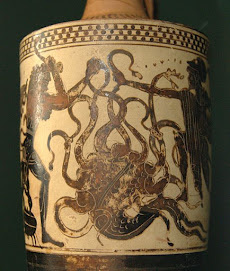
The monster was more specifically called the Lernaean Hydra, after the coastal springs and fresh lake area that formed the waters, known as Lerna Lake. Today, the water source is extinct. It sits right near the ocean shores east of Arkadia. The monster that lived there was said to have nine or ten heads, depending on the source, and that each time one was cut off, more would regrow. Not only was the beast of immense size and power, it possessed deadly and poisonous breath and blood. Herakles managed to defeat the creature by cutting off eight heads and burying the ninth under a rock.

In the picture above, we see an ancient depiction of Herakles fighting the Hydra. We may not think at first glance that the Hydra looks a lot like an octopus. Octopuses have eight arms and one head, making nine ends, and if they lose an arm, it can regenerate the lost limb in pristine condition. The arms even have their own minds. The animals can also grow to immense size and possess incredible strength. They also carry very painful and deadly venom that can be inflicted upon prey or opponents. Is it possible that the Hydra was exactly this, and that Herakles managed to kill after it had haunted the inhabitants of the area with deadly attacks and/or harassment? They can most certainly kill a human very easily with their poison, and depending on size, might even be able to drown a victim. I think the evidence all points to a very menacing, multi-limbed water monster that we today call the octopus, and to take out one of this magnitude on its own turf with bear hands and sword, would be something most definitely unique and Heroic. The only setback is the fact that the Lake was a freshwater source, and these animals cannot live in that. But who knows? In ancient times, there might have been a part that flowed into it from the sea, or perhaps the inhabitants just thought that the creature came from the Lake but didn't always live there. Maybe the actual battle took place in the sea.

Assuming I am correct, these monsters still live with us today in abundant numbers. The hydras have even become a favorite meal, interestingly, in the Mediterranean, and far East. But generally, they are simply beautiful and fascinating creatures to watch and study. They've even been known to create their own communities. They are very intelligent and resourceful, and have been here for nearly 300 million years, which predates modern humans by a long shot. If only they had been able to talk and take notes, what a world of fascination they could reveal to us.

So the next time you take a dip at the beach, don't forget that the Hydra may still be watching, and in the case that you encounter one, it's probably not a good idea to try to be another Herakles if you can avoid it. There was only one.

In the Goodness of the Gods,
Chris Aldridge.

Tuesday, March 1, 2022

Fire Didn't Raise No Fool

Prometheus gave humans fire in order to advance our minds, that is what the ancient Greeks believed. Humans were made last, and there was nothing left to give us in the way of natural weapons or abilities, and so the Gods gave us an amazing mind, that we could be superior to all the animals around us. The beginning of that development was the gift of fire that the Titan blessed us with. While most people of our modern Age may think nothing of the story outside of a cultural worldview long passed, science proves that it's actually true. As with mostly all the Myths, our educational system of today leads us to discount rather than examine them.

Prehistoric man did indeed have fire, and we now know that because they had fire and were able to cook with it, the human brain grew. Because of the fact that food became more digestible, far more nutrients went into the body as opposed to earlier primates who couldn't use the tool. In short, it is a literal fact that the gift of fire advanced the human mind. In the broader view of humanity, it literally gave a rocket boost to human evolution itself. Fire later became used in sacrifices and was considered a sign of the presence of a God. Fire, when big enough, would also keep nightly predators away, and so it became known as that which drives away evil. 

Of course, the ancient Greeks had no knowledge of this prehistoric and modern science, so how did they know? Who told them? The Higher Powers and Intelligences of the universe, whom all humans have an inherent connection and quest for because of schema, created that realization. Simply put, the Gods told them. Today we are often raised and trained to be afraid of fire. I remember when I was growing up, just lighting a stove scared or made me very nervous. We should most certainly be careful with it, because after all, it did come from Powers beyond our control, but I think that the more we grow accustomed to the natural world and our natural selves, we understand the Divinity and wonderfulness of it all. 

In the Goodness of the Gods,

Chris Aldridge.

Thursday, February 24, 2022

Holy War That Shook Ancient Greece To The Core

As we saw in the First Sacred War, the victory of the League of Delphi resulted in the destruction of the town occupying its harbor and the restoration of Apollon's Temple. Delphi had won her first holy conflict, but it would be only the beginning of religious and economic fights over the center of the Greek world. 

Athens has always taken powerful and pivotal roles in ancient Greek history, and even today they hold tremendous influence as the capital of modern Greece and the most populated City of the nation. Although, we must remember that in ancient times, Greece or Hellas was not a unified land. Each City State had its own government, laws and religious observances. In the decade of the 440s BCE, the imperial power of the City of Athens began to flex its muscle into central Greece, and the fact that Delphi was there did not go unnoticed, neither by Athens or its biggest rival City, Sparta.

Not only had Athens spent a lot of time, money and effort dominating the Delphic sanctuary with their own dedications and even a treasury whose ruins still stand today, but Athens also started to control and influence all the areas around or within proximity of Delphi, and the people who would strike this match were the Phocians. Phocis was a central region of Greece in which Delphi resided, and the people wanted to incorporate it into their jurisdiction, probably not only because of the influence it held over the Greek world, but the immense amount of wealth that was accumulating there. But it appeared as though the Phocians were not strong enough to do it on their own. They managed to enlist the powerful aid of Athens in removing the independence of Delphi.

Sparta had frequently consulted the Oracle of Delphi and had begun establishing their presence in the sanctuary. They did not like the fact that Athens was literally the master of the Temple and the City, so they decided to send troops to overthrow the Phocian control and return Delphi to its full independent state in 449 BCE. Sparta succeeded and Delphi was again ruled by Delphi alone, which the people of the City and Temple were extremely grateful for. They even erected dedications to the Spartans for their liberty. 

However, the victory was brief. Two years after the Spartans left, Athens sent its troops under the command of Perikles and restored Phocian rule, establishing a tug of war in central Greece. But by 445 BCE, independence was again won by Delphi, noting the fact that Athens had to eventually turn its attention fully to Sparta in the Peloponnesian War by 431. Athens, at that point, simply did not have the time or power to keep Delphi locked, and would end up losing the war to Sparta after nearly 30 years of brutal fighting. Further conflict would not return to the City of Delphi for around 100 years later, what would come to be known as the Third Sacred War. For the time being, Delphi would once again remain a free State.

Read my post on the First Sacred War here. 

In the Goodness of the Gods,

Chris Aldridge.

Sources

Scott, Michael, Delphi, A History of the Center of the Ancient World, Princeton Publishing, 2014.
Monday, February 14, 2022

I Knew She Was Real That Day

I hadn't had much luck with women by that point in my life, either because they didn't like me or I was too stupid in my youth to recognize the signals (and we can only thank the oppressive social norms of modern society for that). By 2005, I had only been with two women in my life, and one I didn't even sleep with. One might could say it wasn't even an actual relationship because she was not loyal to me at all, in any way. But by that year, a change had also entered my life. I first discovered the Greek Gods as a religion. I did not know all of the Gods or even how to practice Hellenism, but I knew of and felt connections with the Olympians. Aphrodite was one of my closest (and still is).

While I hadn't had a successful romantic life, I knew Aphrodite was the Goddess not only of love but sex and beauty, and it was for the latter two attributes that I decided to pray to Her. My request was simple: make me more attractive to the opposite sex. Each time I prayed for that, I would notice women looking at me more when I was out in public. Aphrodite possibly enhanced my beauty, or perhaps I was beautiful all along and the Goddess helped people notice me more. After my connection with Aphrodite, my romantic and sexual encounters only became more frequent. In 2009, I met the love of my life who would become my wife (I am still married to her to this day). From the first day She blessed me, I knew Aphrodite was real.

Valentine's Day, the day of love, makes me think back onto those early days when the Greek Gods first showed their wonderful selves to me. I don't think Aphrodite cared that I wasn't actually a Hellenist at that time. I was Hellenic in my heart, and She cultivated that into the pious man I am today.

In the Goodness of Aphrodite,

Chris Aldridge.

Monday, February 7, 2022

How Do You Release All Your Doubts?


"I think you're awesome," a very close friend of mine said. "Why?" I asked. "Because you're so spiritual. I wish I had your faith. You have no doubts at all."

I do not consider myself to be anything special or profound. I'm just a man being himself and doing what he loves and believes in. But at the same time, there are some people in my life who think I'm the greatest thing since sliced bread. And there is certainly something undeniable in what they said, I have always had incredibly strong faith no matter what has happened or hasn't happened in my life. Growing up dirt poor, struggling through my young adult life, having a premature child, enduring years of hardship as a parent; there were many things that would attack the spirit of some other people. But not me. Why is that and how do I release myself from doubt?

For starters, I think my spiritual upbringing plays a part, even though it was an entirely different theology. Several religions, despite their vast disagreements, can at times agree on some human values, or at least not devalue them. I grew up in a religiously conservative community and environment in the South. Enduring faith as a concept in and of itself, was instilled into me. I was taught that belief in deity was vital.

Is it also possible that someone could be born with inherent faith? I certainly think so. We are born with schema, which enables us to look for Higher Powers in the universe, and so we are always looking for Gods even from the time we are born. For as long as I can remember, I have been in love with the natural world and could always see the powers and minds behind it all. I still retain that mindset and interpretation to this day. I can't disbelieve in the Gods just as I cannot disbelieve in anything else around me. I can't disbelieve in the Sun, Moon, the forests or oceans because they're obviously there.

Finally, I would call it bliss. I've heard people in the Hellenic community say that we do not worship the Gods because we want something in return, but simply because it makes our lives more blissful. I cannot logically deny that the Gods have given me so many blessings and helped me through all of my hardships. Yes, life has had trials, but the Gods are the goodness we can always experience, and that can help us overcome our problems.

In the Goodness of the Gods,
Chris Aldridge.